
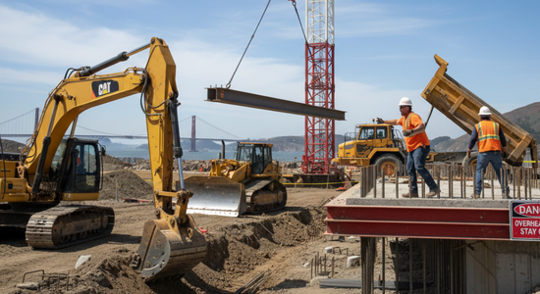
You feel a job site wake up. Backup alarms. Radios. Diesel in the air. A foreman calling for the next delivery. And the quiet pressure to keep moving, even when something looks risky.
Heavy machinery can hurt people fast. It is not always a dramatic mistake. Sometimes it is a tight work zone, a missed signal, worn equipment, or a rushed plan that puts workers in the wrong place at the wrong time.
This page is written for workers across California, including freeway and bridge jobs along the 405, 101, and I-5, port-adjacent projects near San Pedro and Long Beach, redevelopment work near Downtown Los Angeles, Koreatown, and Hollywood, and industrial builds across the Inland Empire and the Central Valley.
If you were hurt, The Work Justice Firm can help you with workers’ compensation and also look at employment law problems that show up after a report, like retaliation, schedule cuts, or pressure to return early.
Common Types of Heavy Equipment Construction Accidents on California Sites
When people think “construction accident,” they often picture a fall from height. Falls are common, but heavy equipment incidents tend to be more severe because of weight, force, and limited reaction time.
Here are the incidents we see most often:
- Struck-by accidents, including swing radius hits and falling or shifting loads
- Caught-between and crush injuries, including pinning against walls, barriers, or other equipment
- Runovers and backovers, often in staging areas and tight access roads
- Rollovers and tip-overs, including lifts, forklifts, loaders, and earthmovers
- Crane and hoisting incidents, including rigging failures and uncontrolled load movement
- Trenching and excavation incidents, including equipment positioned too close to the edge
- Collisions between machines, trucks, and delivery vehicles on site routes
- Mechanical failures during use, including brake, steering, or hydraulic issues
Those are the common types of heavy equipment construction accidents that tend to cause the most serious harm.
The Most Common Types of Construction Accidents Overall
If you zoom out beyond heavy machinery, the most common construction accident categories still show up in California work injuries:
- Falls from scaffolds, ladders, roofs, and openings
- Slips and trips on debris, uneven surfaces, and wet areas
- Struck-by incidents from materials, tools, or vehicles
- Caught-in or caught-between incidents involving moving parts and pinch points
- Electrocution and arc flash exposure
- Trench collapses and confined-space incidents
So what is the most common type of accident in the construction industry. Many sites see falls as the frequent one. But the injuries tied to heavy equipment can be more catastrophic, even when they happen less often.
Which Heavy Equipment is Most Often Involved in Accidents
Different sites use different machines, but a few keep showing up in injury reports because they have blind spots, tight turning space, and heavy loads.
Equipment that is often involved includes:
- Excavators and backhoes, especially during swing and trench work
- Skid steers, especially in congested work zones
- Front-end loaders, especially when reversing or carrying loads
- Dozers and graders, especially on uneven ground and low visibility routes
- Forklifts and telehandlers, especially with elevated or off-center loads
- Boom lifts and scissor lifts, especially on poor surfaces or in wind
- Dump trucks, especially in staging and backing operations
- Cranes, especially during rigging, signaling, and load travel
If you work around heavy construction equipment accidents, it helps to know what the big risk is for your machine. For some it is the blind spot. For others it is instability, load shift, or swing radius.
Common Causes of Heavy Equipment Accidents On Construction Sites
Equipment incidents rarely come down to one moment. The cause is often a chain.
Common causes include:
- No clear traffic plan for equipment and foot traffic
- Poor visibility, including dust, glare, low light, or blocked sightlines
- No dedicated spotter, or spotters pulled to other tasks
- Rushed schedules, including night work and short lane closure windows
- Unsafe ground conditions, including soft soil, slopes, and broken pavement
- Incomplete training, including unfamiliar attachments or controls
- Missing or ignored safety rules, including lockout procedures and signaling rules
- Equipment maintenance problems, including worn brakes, tires, alarms, and hydraulics
These causes also connect to broader factors like human error and equipment failure. A tired operator, a confusing site layout, and a machine with a known issue can collide in one quick moment.
Struck-By Injuries and The Swing Radius Problem
Struck-by incidents often happen because a worker is near moving equipment or a moving load.
Examples:
- An excavator swings and the counterweight clips a worker
- A loader reverses and a worker is behind it
- A dozer changes direction and someone steps into its path
- A crane load swings because the tag line is not controlled
- Material slides off forks or a bucket during transport
It is easy for management to say, “Stay out of the way.” On real sites, the “safe” walkway may not exist, routes change, and noise makes communication hard. When the area is not set up for separation, the risk jumps.
Crush, Caught-Between, and Runover Injuries in Tight Zones
Caught-between and runover injuries often happen in bottlenecks, staging areas, and access roads.
Common scenarios:
- A worker pinned between equipment and a barrier or wall
- A worker crushed between a machine and a trench box
- A worker caught between a lift and an overhead beam
- A worker run over during a backing operation when a spotter is not present
- A worker struck during a multi-trade rush when machines and people share a corridor
These incidents are also where finger-pointing starts fast. That is why it helps to write down the basics early, even if you are still shaken up. What machine. What direction it was moving. Who was supposed to spot. Where cones and barriers were placed.
Rollovers, Tip-Overs, and Load Shift
Rollovers and tip-overs are common when ground conditions are poor or the machine is used outside safe limits.
Factors that raise risk:
- Side slopes, especially with a raised load
- Soft soil or recently backfilled areas
- Turning sharply in a tight space
- Traveling too fast over ruts, curbs, or broken pavement
- Using attachments that change balance without adjusting operation
- Moving an elevated lift when it should be repositioned and lowered
This is another area where common types of heavy equipment construction accidents tie back to planning. A safer route, better grading, or a slow-down rule can prevent a tip-over.
Top Causes of Construction Fatalities and The Injuries We See Most
When aheavy machine is involved, injuries are often severe. Common injuries include:
- Head injuries and traumatic brain injuries
- Crush injuries, including internal organ damage
- Back and neck injuries
- Fractures and complex breaks
- Amputations and severe hand injuries
- Burns, including from fuel, electrical, or hot surfaces
- Fatal injuries in high-force incidents
People also ask about the top causes of construction fatalities. Many safety discussions point to four broad buckets:
- Falls
- Struck-by incidents
- Caught-in or caught-between incidents
- Electrocution
Heavy machinery can be part of more than one of these buckets, especially struck-by and caught-between events.
Employer Responsibilities For Heavy Machinery Safety
Employers and site controllers have aduty to keep the workplace reasonably safe. On heavy equipment sites, that usually means more than handing out a vest and hoping for the best.
Safety responsibilities often include:
- Creating a traffic control plan that separates machines and pedestrians
- Providing training for operators and ground workers on signals and safe zones
- Enforcing spotter use where visibility is limited
- Keeping equipment in safe condition, including alarms, lights, brakes, and hydraulics
- Providing proper protective equipment when required
- Addressing hazards that workers report, instead of brushing them off
- Keeping job site rules consistent across subcontractors
When those basics are missing, heavy equipment accident risk rises. If a worker speaks up and then gets punished, that can also raise employment law concerns.
What To Do After a Heavy Equipment Accident at Work
If you are injured, it is normal to feel torn. You want help, but you do not want trouble at work. Still, the next steps matter.
A practical checklist:
- Get medical care right away. If it is urgent, call 911.
- Report the accident to a supervisor as soon as you can. If possible, do it in writing.
- Tell the medical provider it happened at work and describe how it happened.
- Ask for a copy of any incident report. If you cannot get it, write down what you remember.
- Save names and contact info for witnesses.
- Write down the equipment involved, including the make, model, or unit number if you know it.
- Keep notes on symptoms that show up later, like dizziness, numbness, or new pain.
If someone pressures you to say it happened off the clock, to use personal insurance, or to “sleep it off,” treat that as a warning sign.
Local California Details That Make a Consult Easier
If you are injured, travel can feel harder than it should. Here are a few practical, California-specific tips workers ask about.
Neighborhood and corridor anchors
- Downtown Los Angeles, Koreatown, Hollywood, and the Westside near the 10 and 405
- San Pedro and Long Beach port corridors
- Inland Empire build zones around Ontario, Fontana, Riverside, and the 60 and 15
- Bay Area industrial routes near I-880, Oakland, and parts of San Jose
- Central Valley routes near Bakersfield and Fresno
Transit options
- Los Angeles County: Metro Rail and Metro Bus can help if driving is difficult
- Bay Area: BART and Caltrain are often easier than fighting traffic
- San Diego: the Trolley can be a solid option for Downtown-area trips
Parking
- Metered street parking is common in dense areas
- Paid lots can reduce walking time if mobility is limited
- Give yourself extra time so you are not rushing
Talk With The Work Justice Firm After a Heavy Equipment Injury
If you were injured by heavy equipment in the workplace due to negligence, you may be eligible to workers' compensation for your economic and non-economic damages. it is important to seek the legal help of an experienced construction accident lawyer following your heavy machinery accident to ensure that your claim is strong and protected.
The Work Justice Firm represents workers in workers’ compensation and employment law matters, and we can help you understand what benefits may apply and what evidence matters.
Contact us today for a free consultation! Or visit us at workjustice.com to find out more about what our legal team can do for you.